
The Construction Industry’s AI Problem
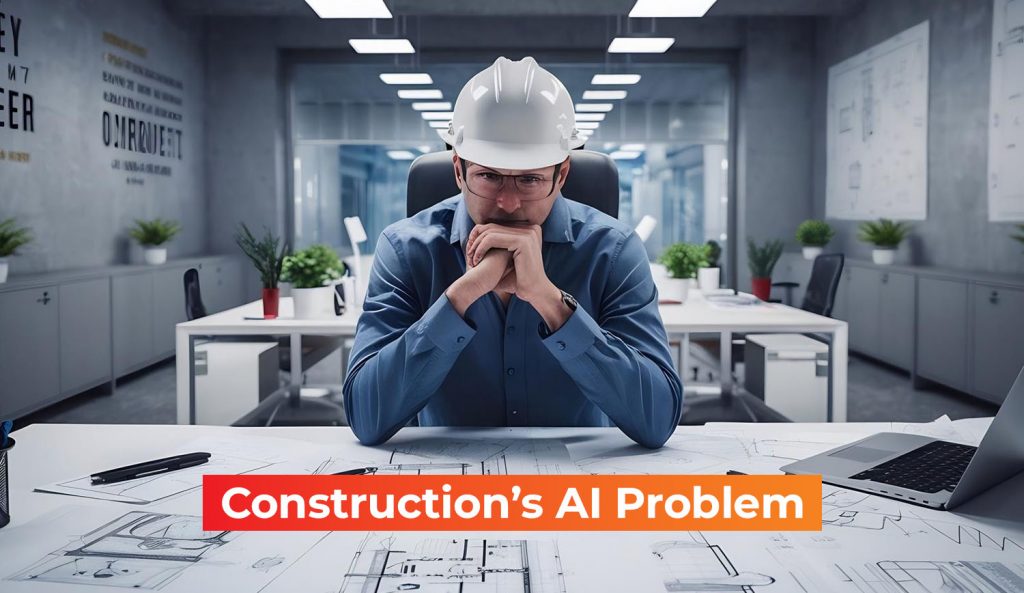
Construction is one of the oldest industries in the world. It is also one of the most stubbornly unproductive.
Despite billions invested in construction tech over the last decade, global productivity has risen just 1% annually for 20 years—far less than in manufacturing or agriculture.
Meanwhile, software vendors are louder than ever. Digital twins. AI-powered project management. Autonomous site equipment. Predictive analytics. The pitch decks are polished. The conference stages are full.
Meanwhile, most mid-sized contractors still chase invoices, manage overruns in spreadsheets, and firefight on site—just as they did years ago.
The gap between what the industry is being sold and what works on the ground is the real AI problem in construction.
Takeaway: adoption lags far behind innovation in most businesses.
The Ground Reality Nobody Talks About at Conferences
Walk into any major construction technology event and you will find the same story told with great confidence. AI is transforming the job site. Digital twins are creating living models of entire infrastructure projects. Machine learning is predicting delays before they happen.
Some of that is true—for a very specific group of companies.
The firms leading these transformations are typically large-scale infrastructure players, Tier 1 contractors, or companies backed by significant capital with dedicated technology teams, mature data pipelines, and the organisational bandwidth to absorb multi-year implementation cycles. We are talking about companies with technology budgets that exceed the total annual revenue of many mid-sized contractors.
For everyone else, the reality looks quite different.
According to a 2023 report by Autodesk and FMI, the construction industry loses approximately $1.8 trillion globally each year due to poor data and miscommunication. Yet despite this, the majority of mid-sized construction firms have yet to implement foundational data practices, let alone AI-powered systems built on top of them.
The technology is not the bottleneck here; the readiness is.
Impressive on Stage, Complicated in Practice
Let’s be clear about the technologies getting the most attention right now and what they demand from a business before they deliver any return.
Digital Twins
A digital twin is a live, data-fed virtual model of a physical asset or project. In theory, it provides project teams with real-time visibility, scenario planning capabilities, and a single source of truth across the entire build. It starts as a 3D KPI dashboard and builds into a prediction and audit tool.
In practice, a digital twin requires the right sensors in the right positions across a site. It needs edge computing to interpret the signal from those sensors. Then there is a cloud-based model to manage what that data does. Then, and only then, do you build a user interface that represents the dynamic insights into site management.
Most contractors do not have enough clean data to make a spreadsheet meaningful, let alone a digital twin. They don’t have the skilled people to manage and interpret the data from cameras, sensors, BIM models and site operations, and link them to inventory, procurement and finance. Digital systems in many mid-sized firms do not yet talk to each other.
That is not a criticism. It is a sequencing problem. Digital twins are a destination rather than a starting point. Selling them as a straight up solution is where the AI industry goes wrong.
AI-Powered Project Management Platforms
The promise here is compelling. Predictive scheduling. Automated risk identification. Real-time cost tracking. Intelligent resource allocation. These platforms claim to take the chaos out of project management and replace it with clarity.
What the demos rarely show is the volume of historical, standardised data these systems need to generate meaningful predictions. Feed them inconsistent or incomplete data, and the “intelligence” they produce is unreliable at best, and actively misleading at worst.
Autonomous Equipment and Robotics
This one generates genuine excitement. Autonomous excavators, rebar-tying robots, and drone-based site surveys. The technology is real and improving rapidly.
It also sits squarely in the world of R&D budgets, large-scale infrastructure projects, and companies with the operational capacity to pilot, fail, and iterate. For a contractor juggling up to fifteen projects at a time, autonomous equipment is a five-year conversation, not a current priority.
The Pattern
None of these technologies is bad. They all work in the right environment. The problem is the mismatch between where a technology is on the maturity curve and what that means for the business adopting it. The requirements are too great for most mid-sized contractors today.
Takeaway: match solutions to organisational capacity for best results.
The sales cycle is aggressive. The pressure to “not fall behind” is real. And the result is companies spending significant money on solutions that were never right for their stage of growth.
Why Mid-Sized Contractors Are the Most Exposed
There is a specific vulnerability that comes with being a mid-sized construction business.
Large contractors have dedicated technology functions and people whose only job is to evaluate, implement, and manage technology.
Mid-sized businesses are complex enough for big problems, sufficiently resourced to be a target for vendors, but rarely do they have someone dedicated to making smart technology decisions.
Add to that the fear factor. Competitors seem to be moving. The industry press is full of transformation stories. Boards and senior leadership are asking questions about AI strategy. The pressure to act, buy something, and announce your AI strategy is building.
In construction, where margins are tight and cash flow is king, a failed technology implementation does more than waste money. It can cause injuries, or worse. It will consume the energy and focus of the people who keep the business running.
The stakes of getting this wrong are high.
The High-Impact Wins Available Right Now
There is a category of automation that does not require a transformation programme, a new data infrastructure, or a dedicated technology team. It requires honesty about where time and money are actually being lost.
For most mid-sized construction businesses, the highest-impact opportunities look like this:
- Back-office automation — invoicing, purchase order processing, compliance documentation, and subcontractor onboarding. These are repetitive, rules-based tasks that consume skilled people’s time and introduce errors when done manually.
- System integration — most construction businesses run separate tools for ERP, site management, and finance that do not share data. Connecting these systems eliminates duplicate entry, reduces errors, and gives leadership a clearer picture of business performance.
- Estimation support — AI tools that analyse material cost trends, flag scope anomalies, and benchmark against historical project data can meaningfully improve margin without requiring a complete overhaul of how estimates are built.
- Field reporting — simple, mobile-first tools that site teams will use. The value is not in the tool’s sophistication. It is in the consistency of the data it captures.
These are not headline-grabbing technologies. They are also not small wins. Done well, they reduce administrative overhead, improve cash flow visibility, and lay the data foundation for more advanced capabilities to come.
Data Is the Real Foundation
Every meaningful AI application runs on data. Clean, consistent and structured data. And the truth is that most construction businesses do not have it yet.
Getting data in order means standardising how projects are set up, how costs are coded, how progress is reported, and how completions are documented. This must be consistent across every project, site and team. That discipline, built over time, becomes a competitive advantage. It is the foundation on which smarter decisions get made, with or without AI.
Takeaway: Invest in data discipline now to unlock future benefits.
Where MSBC Comes In
MSBC Group has spent over two decades working with construction businesses. We don’t sell from the outside, but rather embed within them as part of the team. Our engineers understand the pressure of project margins, the complexity of contractor operations, and the gap between what technology promises and what it delivers in practice.
That context matters enormously when it comes to AI and automation.
For us, the starting point is always the business, the workflows, the data, the team, and the goals. A technology recommendation flows from there.
If a technology will not work for a business, we will say so. Our only goal is to build an advantage through the right capabilities, in the right sequence, at the right pace.
The Right Question
There will be another construction technology conference next quarter. The digital twin vendors will be there. The AI platform companies will be there. The slides will be impressive.
The contractors who come away with an advantage will not be the ones who were most excited by the demos. They will be the ones who walked in with a clear sense of the problem they were trying to solve and left when they found something that addressed it.
The question worth asking is not “How do we get AI into our business?”
It is “What problem, if solved with AI, would change our numbers?”
Start there and everything else follows.MSBC Group works with mid-sized construction such as Northvale to design and implement AI & technology strategies that deliver measurable business outcomes. If you are trying to separate signal from noise on AI and automation, start with a conversation.